
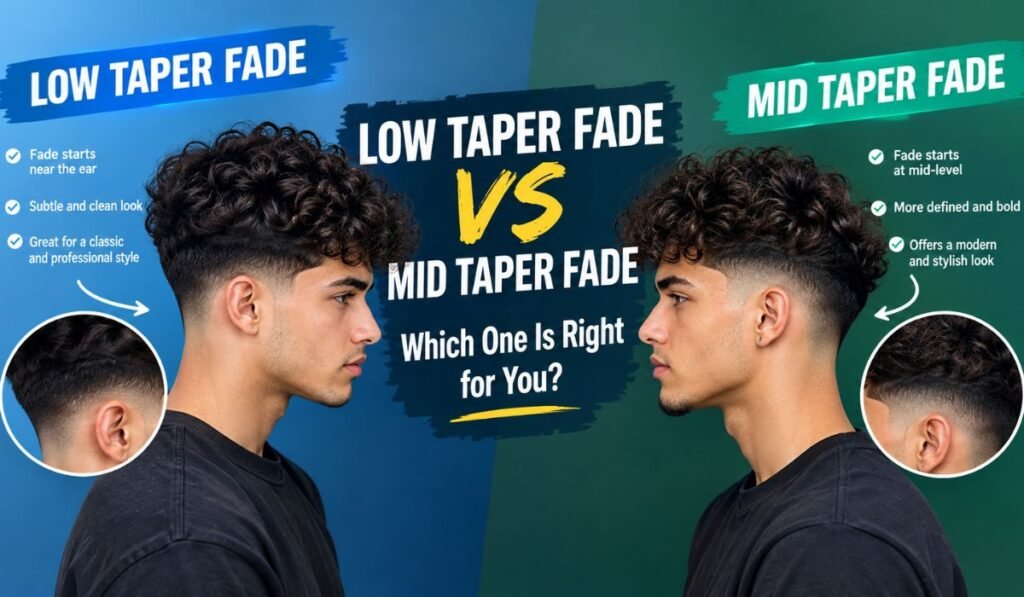
Choosing a new haircut always comes down to small details that make a big difference, and the low taper fade vs mid taper fade debate is a perfect example. Both cuts are clean, modern, and low-maintenance compared to a full skin fade, but they sit on your head differently, grow out differently, and suit different faces and hair types.
If you’ve ever sat in the barber’s chair and frozen when asked “how high do you want the fade?”, this guide fixes that. By the end, you’ll know exactly where each fade starts, how it looks, who it suits, and what to say next time you’re in the chair.
The short version
Here’s the whole low taper fade vs mid taper fade comparison in a nutshell:
- Low taper fade — the blend starts just above the ear and along the neckline. Subtle, conservative, and great for work.
- Mid taper fade — the blend starts higher, around the temple. Sharper, bolder, and more noticeable.
- Low taper fade grows out slower and needs fewer barber trips.
- Mid taper fade shows off more contrast and pairs well with textured or curly tops.
If you want a safe, professional cut that blends in, go low. If you want a sharper, more styled look that stands out, go mid. That’s the core of the low taper fade vs mid taper fade choice — everything else in this guide simply builds on that.
What is a low taper fade?
A low taper fade keeps the fading action close to the bottom of your head. The transition begins just above the ears and wraps around the back of the neck, gradually shortening the hair until it blends into the skin or a very short guard length.
Because the fade starts so low, most of the length on the sides stays intact. From a distance, a low taper fade barely looks like a “fade” at all — it just looks like a neat, well-groomed haircut. That’s exactly why it’s the most requested style among professionals, students, and anyone who wants a clean look without drawing extra attention to the sides of their head.
Key features of a low taper fade:
- Fade line sits just above the ear and around the neckline
- Keeps more hair volume on the sides
- Soft, gradual transition with no harsh lines
- Looks polished in formal and casual settings alike
- Grows out slowly, so it stays neat for weeks
This is one half of the low taper fade vs mid taper fade conversation, and it’s usually the “safer” pick.
What is a mid taper fade?
A mid taper fade moves the starting point of the blend higher up the head, usually right around the temple, roughly where your sideburn meets your hairline. Instead of hugging the neckline, the fade wraps around the sides at ear height and above, exposing more skin before blending into the longer hair on top.
This creates noticeably more contrast between the top and the sides. A mid taper fade looks sharper, more deliberate, and more “styled” than a low taper fade, which is why it’s popular with younger clients and anyone who wants their haircut to be part of the overall look rather than something in the background.
Key features of a mid taper fade:
- Fade line starts around the temple, level with the top of the ear
- More visible skin and stronger contrast on the sides
- Pairs naturally with textured, curly, or voluminous tops
- Reads as modern and intentional in photos
- Needs slightly more frequent trims to stay sharp
Put side by side, the low taper fade vs mid taper fade difference really comes down to one number: how high the blend starts.
How the two look side by side
Here’s a quick table to visualize the low taper fade vs mid taper fade comparison:
| Feature | Low Taper Fade | Mid Taper Fade |
| Fade starting point | Just above the ear / neckline | Around the temple |
| Contrast level | Soft, subtle | Sharper, more visible |
| Hair kept on sides | More | Less |
| Best for | Conservative, professional looks | Modern, bold looks |
| Grows out in | 3–4 weeks | 2–3 weeks |
| Barber visits | Less frequent | More frequent |
| Face shapes flattered | Longer, oval faces | Round, square faces |
| Styling effort | Minimal | Slightly more |
This table alone answers most of the low taper fade vs mid taper fade questions people ask their barber, but let’s break each factor down properly.
Read Related Post: Classic Taper Haircuts: 60+ Styles, Types, Barber Tips & Expert Guide
Which one looks more professional?
If you work in a traditional office, law firm, bank, or any conservative environment, the low taper fade is usually the safer bet. The subtle blend doesn’t draw the eye, so the focus stays on your face rather than your haircut.
The mid taper fade isn’t unprofessional by any means, but it does look a little more “done” and stylish, which fits better in creative industries, hospitality, or casual workplaces.
Quick guide:
- Corporate or formal workplace → low taper fade
- Creative, casual, or client-facing but relaxed job → mid taper fade
- Student or everyday wear → either works, depending on how bold you want to look
So when people ask about the low taper fade vs mid taper fade for job interviews or office settings, low taper almost always wins.
Which fade suits your face shape?
Your face shape plays a big role in how flattering each fade will look.
- Round or square face → A mid taper fade adds visible height and slims the sides, breaking up width.
- Oval face → Both fades work well; oval faces are the most versatile.
- Long or rectangular face → A low taper fade keeps more hair on the sides, which balances length instead of adding more height.
- Heart-shaped face → A low taper fade with some length on top softens a narrow chin, while a mid taper can work if paired with a fuller top style.
This is one of the most searched parts of the low taper fade vs mid taper fade topic because a cut that suits your friend’s face shape might not suit yours.
Which one works better for your hair type?
Hair texture changes how each fade behaves and how much upkeep it needs.
| Hair Type | Better Fit | Why |
| Straight, fine hair | Low taper fade | Keeps a soft, natural look without over-exposing scalp |
| Thick, straight hair | Either works | Thick hair holds shape well at both heights |
| Wavy hair | Mid taper fade | Adds contrast that shows off wave pattern |
| Curly or coily hair | Mid taper fade | Highlights curl definition on top with more visible skin below |
| Thinning hair | Low taper fade | Less contrast means less attention on thinning areas |
If your hair type is uncertain, a low taper fade is the more forgiving option in almost any low taper fade vs mid taper fade decision.
Pairing each fade with popular top styles
Both fades act as a base — the real personality of the haircut often comes from what’s happening on top.
Low taper fade pairs well with:
- Classic side part
- Slicked-back style
- Textured crop with minimal length
- Comb-over
Mid taper fade pairs well with:
- Textured quiff or messy fringe
- Curly top or afro
- Pompadour
- Buzz cut with a faded taper on the sides
This is where the low taper fade vs mid taper fade decision gets personal — pick the fade height that matches the top style you actually want to wear daily, not just what looks good in a photo.
Maintenance: which one lasts longer?
Maintenance is often the deciding factor once looks and face shape are settled.
- Low taper fade: Because the fade sits lower, regrowth is less noticeable. You can usually go 3 to 4 weeks between trims before it starts looking messy.
- Mid taper fade: The higher starting point means new growth shows up faster and blurs the sharp line sooner. Expect to book a trim every 2 to 3 weeks to keep it crisp.
If low-maintenance is your top priority, this single point often settles the low taper fade vs mid taper fade debate on its own.
Everyday styling and products
Neither fade needs a complicated routine, but a few basics keep both looking sharp:
- Wash with a gentle shampoo 2–3 times a week to avoid drying out the scalp along the fade line.
- Use a lightweight pomade or matte clay for natural movement without excess shine.
- Blow-dry on low heat before styling to make the top more manageable.
- Trim the fade line yourself between barber visits using a small trimmer, if you’re comfortable doing so.
- Apply beard oil or scalp oil if the fade exposes more skin (especially useful with a mid taper fade) to prevent dryness.
Styling effort is fairly similar for both, but a mid taper fade tends to need slightly more attention on top since the shorter sides put more visual focus there.
Pros and cons at a glance
Low Taper Fade
Pros:
- Subtle and professional
- Grows out gracefully
- Works with almost every hair type
- Fewer barber visits needed
Cons:
- Less dramatic contrast
- Can look “safe” or plain to some
Mid Taper Fade
Pros:
- Sharper, more modern appearance
- Great for showing off curls and texture
- Adds height to round or square faces
Cons:
- Needs more frequent trims
- Less forgiving as it grows out
- May look too bold for very formal settings
Weighing these pros and cons side by side is the fastest way to settle a personal low taper fade vs mid taper fade decision.
How to ask your barber
Miscommunication at the barbershop usually happens because clients don’t specify the fade height clearly. Use this simple script:
- For a low taper fade: “I’d like a low taper fade — start the blend just above my ears and around the neckline, and leave more length on the sides.”
- For a mid taper fade: “I’d like a mid taper fade — start the blend around my temple, level with the top of my ear, for a sharper contrast.”
You can also bring a reference photo. Barbers see the low taper fade vs mid taper fade request constantly, but showing exactly where you want the fade line to sit avoids any guesswork.
Common mistakes to avoid
- Not specifying the fade height — “just fade it” leaves too much room for interpretation.
- Ignoring your face shape — a mid taper fade on an already long face can exaggerate length.
- Skipping maintenance trims — letting a mid taper fade grow out too long blurs the sharp line and looks unkempt.
- Choosing based on trends alone — what looks good on social media may not suit your hair type or lifestyle.
- Forgetting your workplace dress code — a bold mid taper fade might not fit a strict corporate environment.
Avoiding these mistakes makes the entire low taper fade vs mid taper fade process smoother and the results more satisfying.
Final verdict: low taper fade or mid taper fade?
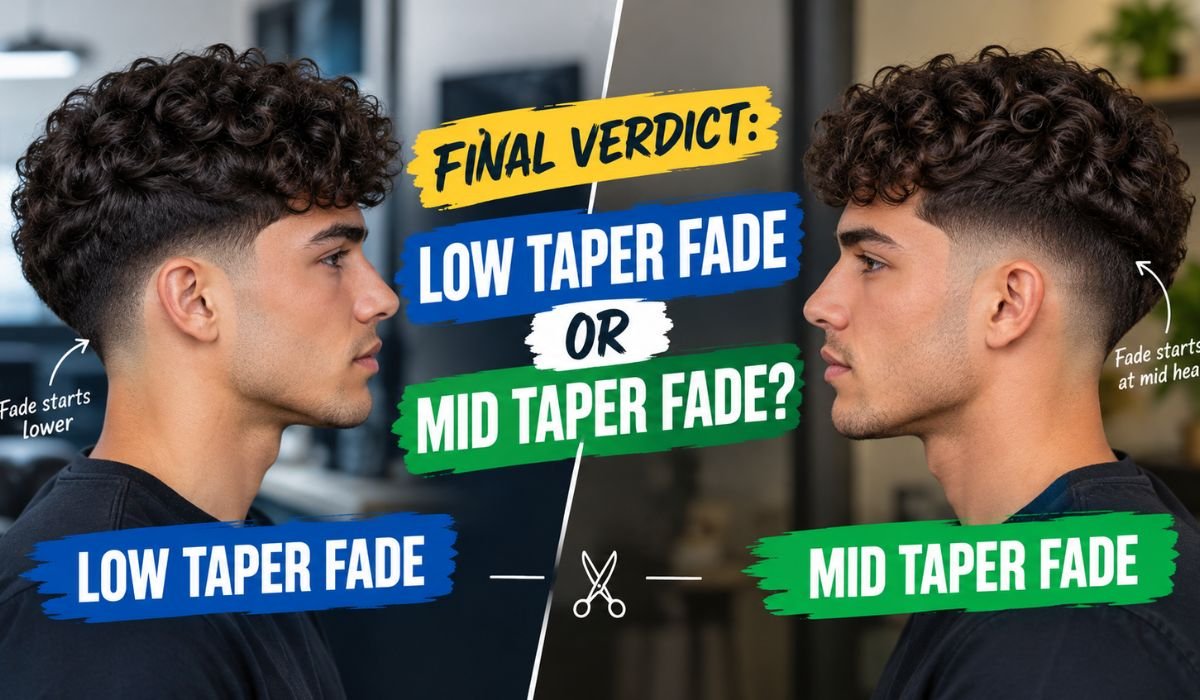
There’s no universal winner in the low taper fade vs mid taper fade comparison — it genuinely depends on your priorities.
- Choose a low taper fade if you want a subtle, professional, low-maintenance haircut that works almost anywhere and grows out gracefully.
- Choose a mid taper fade if you want sharper contrast, a more modern edge, and don’t mind slightly more frequent barber visits.
Both are excellent, timeless choices. The real answer to low taper fade vs mid taper fade comes down to your face shape, hair type, lifestyle, and how much contrast you personally like.
FAQs about low taper fade vs mid taper fade
Q1: What is the main difference between a low taper fade and a mid taper fade? The fade starts near the ear/neckline in a low taper fade, and near the temple in a mid taper fade.
Q2: Which fade is more professional, low or mid taper? The low taper fade is generally seen as more professional because it’s subtler.
Q3: Which fade lasts longer without a trim? The low taper fade lasts longer, typically 3–4 weeks, versus 2–3 weeks for a mid taper fade.
Q4: Does a mid taper fade suit round faces better? Yes, a mid taper fade adds height and slims the sides of round or square faces.
Q5: Can curly hair work with a low taper fade? Yes, but a mid taper fade usually shows off curl texture more clearly.
Q6: Is a mid taper fade higher maintenance than a low taper fade? Yes, it needs more frequent trims to keep the sharp contrast looking clean.
Q7: Which fade is better for a job interview? A low taper fade is the safer, more conservative choice for interviews.
Q8: Can I switch from a low taper fade to a mid taper fade easily? Yes, your barber can simply raise the fade line on your next visit.
Conclusion
At the end of the day, the low taper fade vs mid taper fade choice isn’t about which one is objectively better — it’s about which one fits your face shape, hair type, lifestyle, and maintenance routine.
A low taper fade gives you a soft, professional, easy-to-maintain look, while a mid taper fade delivers sharper contrast and a bolder style statement. Bring this guide to your next barber appointment, describe exactly where you want the fade to start, and you’ll walk out with a haircut you’re confident in — whichever side of the low taper fade vs mid taper fade debate you land on.

I’m Joyce
I’m an SEO-focused writer and content creator with experience in creating useful, search-friendly content that helps readers find the information they are looking for. I enjoy researching trends, understanding what people search for, and turning that research into clear and helpful articles.
At Curl Slayers, I focus on haircuts, hairstyles, fades, and curly hair. I research modern hair trends, different haircut styles, and practical styling ideas to help readers discover fresh looks and choose styles that suit them.
My goal is simple: to make hair inspiration easier to find, understand, and use. Whether you’re looking for a new haircut, a clean fade, a trendy hairstyle, or ideas for your curls, Curl Slayers is here to help you find your next look.

1 thought on “Low Taper Fade vs Mid Taper Fade: Which One Is Right for You?”