
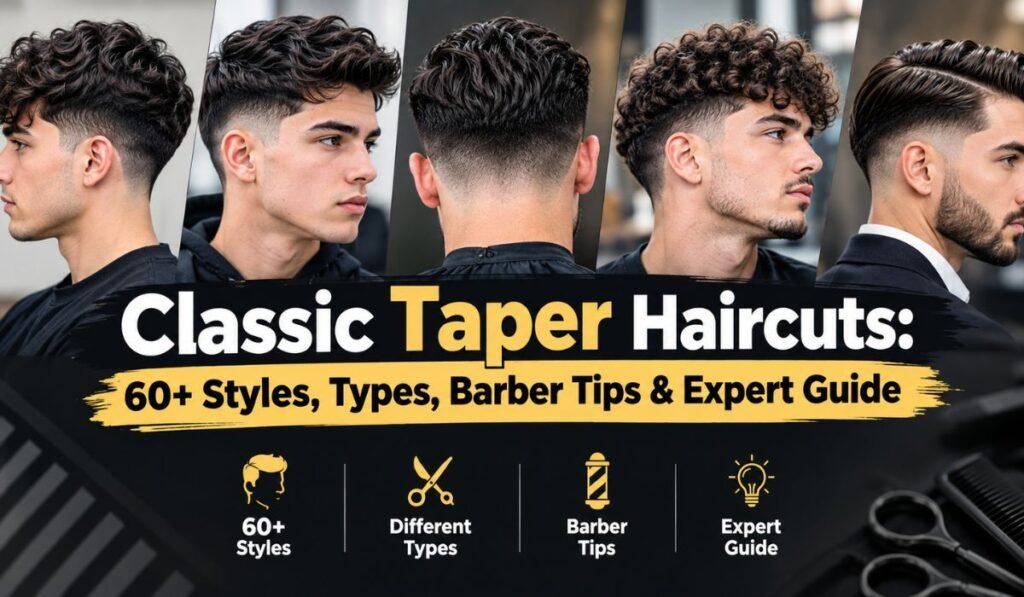
Few haircuts have survived a century of changing fashion. The taper is one of them. Long before fades, undercuts, or hard parts took over Instagram feeds, barbers were quietly perfecting the art of gradually shortening hair from the crown down to the neckline. That skill is still the backbone of nearly every good men’s haircut today.
This guide breaks down everything you need to know about classic taper haircuts — what makes them different from a fade, which style suits your face shape and hair type, how to ask your barber for one, and how to keep it looking sharp between visits. Whether you’re walking into a barbershop for the first time or you’ve worn a taper for twenty years, you’ll find something useful here.
What Is a Classic Taper Haircut and Is It Still Worth Getting in 2026?
Yes — and arguably more than ever. In a year where extreme skin fades and designed hairlines dominate social media, classic taper haircuts offer something different: a look that works in the office, at a wedding, on a first date, and in a job interview, without needing a redo every two weeks.
Barbers describe the taper as the “quiet workhorse” of men’s grooming. It doesn’t chase trends, which is exactly why it never goes out of style.
What is a classic taper haircut?
A classic taper haircut gradually shortens the hair from the top of the head down to the hairline, with no visible line of demarcation. The sides and back get progressively shorter as they move down toward the ears and neck, while the top stays longer for styling flexibility.
Unlike more dramatic cuts, the transition in classic taper haircuts is smooth and subtle. There’s no harsh contrast — just a natural, blended finish that looks tidy from every angle.
What does “classic” mean in the classic taper?
“Classic” refers to the conservative, traditional approach to the cut rather than a specific length. A classic version of the taper typically means:
- A natural, closed neckline (no hard shaved lines)
- Moderate length left on top (roughly 2 to 4 inches)
- A soft, blended transition rather than a sharp fade
- Minimal or no disconnection between sections
In short, classic taper haircuts prioritize timelessness over trend-chasing.
Is a regular taper the same as a classic taper?
Mostly, yes. “Regular taper” and “classic taper” are often used interchangeably by barbers and clients alike. Both describe the same gradual, blended shortening of hair around the sides and back. The word “classic” simply emphasizes the traditional, low-drama styling — natural neckline, softer blend, no aggressive skin fade.
Classic taper vs. fade vs. taper fade: Key differences explained
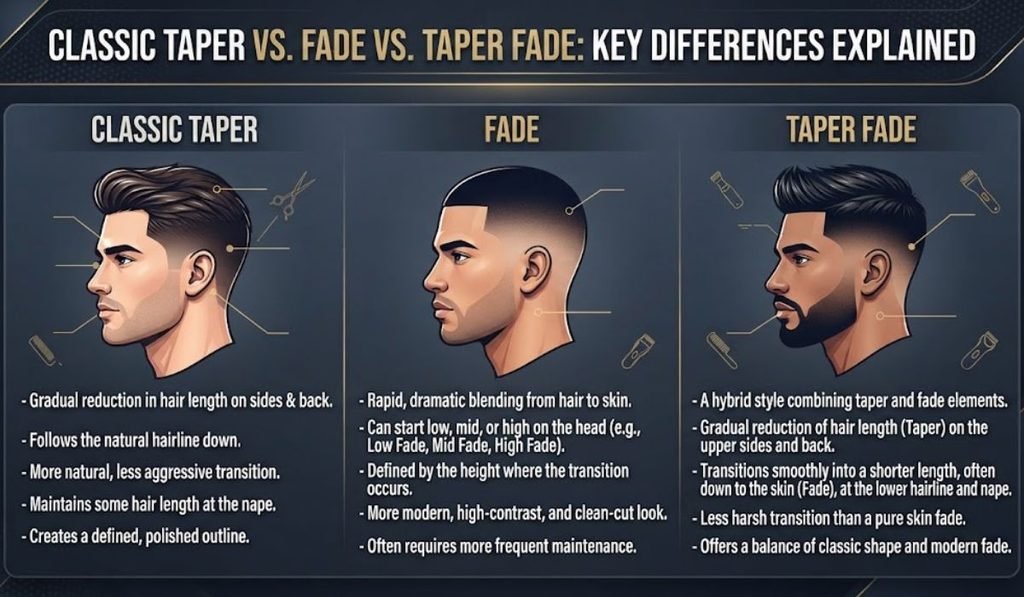
This is the question barbers hear most often, and it’s worth getting straight before your next appointment.
| Feature | Classic Taper | Fade | Taper Fade |
| Shortest point | Roughly 1 cm above the ear | Down to skin (0 guard) | Down to skin, but higher up |
| Transition | Soft, gradual blend | Sharp, dramatic blend | Blend of both approaches |
| Neckline | Natural, untouched | Shaved, defined | Shaved or natural |
| Maintenance | Every 4–6 weeks | Every 2–3 weeks | Every 3–4 weeks |
| Best for | Professional, low-key looks | Bold, high-contrast looks | Modern with classic roots |
The core difference
A fade drops hair length all the way to skin somewhere on the head. A taper never reaches skin — it simply gets shorter without disappearing entirely. That’s the single biggest distinction between classic taper haircuts and fades, and it’s why tapers read as more subtle and grow out far more gracefully.
Read Related Post: High Taper Haircut for Men: 35 Best Styles, Fades & Expert Guide (2026)
What is a classic taper fade?
A classic taper fade combines both techniques: the top and mid-lengths follow the soft, traditional taper approach, while the very bottom of the sides fades to skin or near-skin. It gives you the polish of a fade with the timeless shape of Classic Taper Haircuts — a popular middle ground for men who want a bit more edge without abandoning tradition.
The history of the classic taper haircut: Why it has lasted over 100 years
The taper traces back to military and barbershop culture of the early 20th century, when regulation-style cuts demanded neat, short sides that wouldn’t interfere with hats or uniforms. Barbers refined the technique using hand shears and later clippers, creating the smooth gradient that defines classic taper haircuts today.
Through decades of changing menswear — the Ivy League look of the 1950s, the shag-influenced styles of the ’70s, the gelled spikes of the 2000s — the taper remained the underlying structure. Even hairstyles that look completely different on top usually rely on a taper underneath to keep the sides clean. That adaptability is the real reason it has outlasted almost every competing trend.
60+ classic taper haircut styles for men
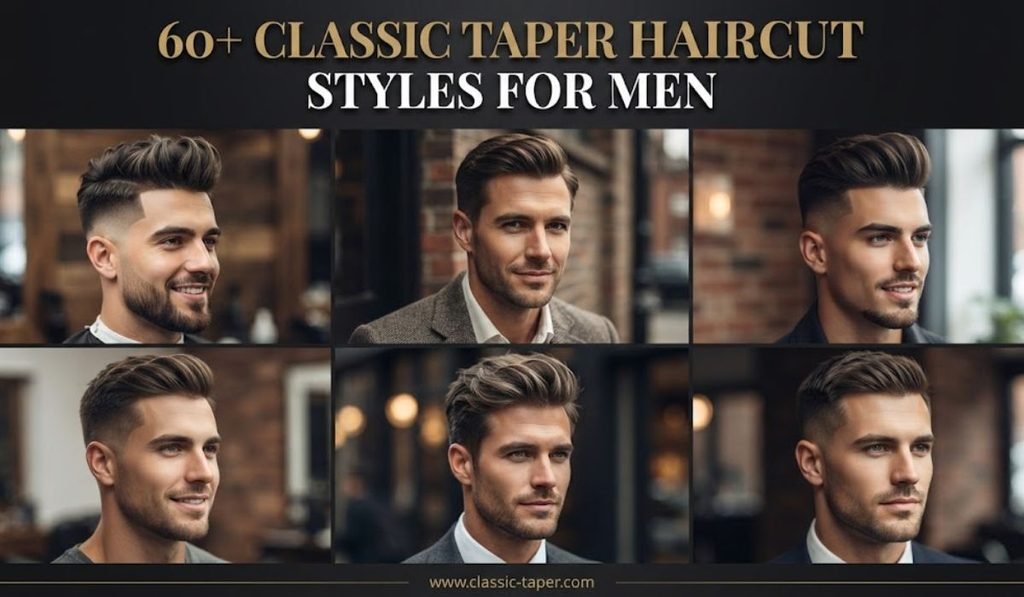
The beauty of Classic Taper Haircuts lies in their versatility. The same technique on the sides can support dozens of different looks on top. Below are the major categories worth exploring with your barber.
Low classic taper haircut styles
The low taper starts its shortening point just above the ear, keeping more length and weight lower down the head. It’s the most conservative option and the safest choice for formal or corporate settings. Popular pairings include a side part, slick back, or textured crop.
Mid classic taper haircut styles (Medium taper)
The mid taper begins around the middle of the head, offering a balance between subtlety and definition. It works well with pompadours, quiffs, and comb-overs, giving just enough contrast to look intentional without appearing bold.
High classic taper haircut styles
Starting near the top of the head, the high taper creates noticeably more contrast between the sides and the top. It draws the eye upward and adds volume perception, making it a good option for thicker or curlier hair types.
Short classic taper haircut
A short classic taper keeps 1 to 2 inches on top — think buzz cuts, crew cuts, and Caesar cuts. It’s the lowest-maintenance version and a favorite among athletes and men in structured work environments.
Long classic taper haircut
A long classic taper leaves 3 to 5 inches on top, supporting slick backs, pompadours, and flow styles. The sides stay tapered while the top offers far more styling freedom.
Classic taper fade styles
For those wanting extra sharpness, taper fade variations blend a shaved or near-shaved base with a traditional top — popular in both textured crop and slick-back combinations.
Classic taper haircut with beard
Pairing classic taper haircuts with a well-groomed beard creates a cohesive, masculine frame for the face. Barbers typically blend the taper into the beard line for a seamless transition rather than a hard stop.
Classic taper for Black men
On coarser or curlier hair textures, Classic Taper Haircuts are often combined with a defined hairline, waves, or a natural top for texture and volume. It remains one of the most requested cuts in barbershops serving Black clientele because it manages shrinkage and curl pattern gracefully.
Additional classic taper variations
- Taper with a hard part
- Taper with a comb-over
- Taper with a brush-up
- Taper with cornrows or braids
- Taper with a undercut disconnection
Classic taper haircut for every face shape: Which style is right for you?
Choosing the right variation of classic taper haircuts for your face shape can make a noticeable difference in how balanced your features look.
Classic taper for a round face
Add height on top with a pompadour or quiff-style taper to elongate the face visually. Avoid excessive width on the sides.
Classic taper for square face
A textured, slightly longer top with a low to mid taper softens strong jawlines without competing with them.
Classic taper for oval face
Oval faces suit almost any variation. A mid taper with a classic side part is a safe, flattering default.
Classic taper for diamond face
Keep some width at the temples and avoid excessive height. A mid taper with soft texture balances the narrower forehead and chin.
Classic taper for a heart-shaped face
A taper with fullness toward the jawline (like a brush-up or textured crop) balances a wider forehead and narrower chin.
Classic taper for oblong/long face
Avoid excessive height. A low taper with a fringe or side-swept top keeps proportions in check.
Classic taper haircut for every hair type
Classic taper for straight hair
Straight hair holds a crisp part and clean lines beautifully, making low and mid tapers especially sharp-looking.
Classic taper for wavy hair
Wavy hair adds natural texture to tapers, working particularly well with brush-up or textured crop styles.
Classic taper for curly hair
Curls benefit from a higher taper that reduces bulk on the sides while letting curls breathe on top.
Classic taper for thick hair
Thick hair pairs well with a high taper to manage volume and prevent a “helmet” look.
Classic taper for fine/thin hair
Fine hair benefits from shorter lengths on top and a lower taper, which creates the illusion of density.
Business classic taper haircut: The professional man’s guide
Why the classic taper is the ultimate business haircut
Classic taper haircuts check every box for professional settings: neat, low-maintenance, easy to style in under five minutes, and appropriate across nearly every industry dress code.
Business classic taper vs. business casual taper
| Aspect | Business Classic Taper | Business Casual Taper |
| Top length | 2–2.5 inches | 3–4 inches |
| Style | Side part, combed | Textured, slightly tousled |
| Product | Light hold pomade | Matte clay or paste |
| Best for | Law, finance, formal offices | Creative or tech workplaces |
How to style the business classic taper for a job interview
- Apply a dime-sized amount of light-hold pomade to damp hair.
- Comb a defined side part.
- Smooth the top flat with a fine-tooth comb.
- Let it air-dry or blow-dry on a cool setting to lock the shape.
Why the classic taper is the best low-maintenance haircut for men
Maintenance comparison table
| Haircut Type | Barbershop Visits | Daily Styling Time |
| Classic Taper | Every 4–6 weeks | 2–5 minutes |
| Skin Fade | Every 2–3 weeks | 3–5 minutes |
| Undercut | Every 3–4 weeks | 5–8 minutes |
How long does a classic taper last?
Most Classic Taper Haircuts hold their shape for four to six weeks before needing a refresh, roughly double the lifespan of a sharp skin fade.
At-home maintenance between barbershop visits
- Trim stray neckline hairs with a beard trimmer
- Use a small amount of pomade or clay daily to maintain shape
- Wash with a gentle shampoo 2–3 times per week to avoid dryness
How to make your classic taper last longer
Keep the top slightly longer at your appointment, and ask your barber to leave a bit of extra length around the taper zone. This buys extra weeks before the cut starts looking grown out.
How to ask your barber for a classic taper haircut
Step-by-step: How to ask for a classic taper
- Specify the taper height: low, mid, or high.
- State your desired top length in inches.
- Mention the finish you want: natural neckline vs. slightly cleaned up.
- Show a reference photo if possible — visuals remove all guesswork.
- Ask for a “blend,” not a “fade,” if you want to avoid a skin-level finish.
Classic taper clipper guard reference table
| Guard Number | Length (inches) | Common Use in a Taper |
| #1 | 1/8″ | Very short taper base |
| #2 | 1/4″ | Standard low taper base |
| #3 | 3/8″ | Mid taper base |
| #4 | 1/2″ | High taper base |
| Scissor-over-comb | Varies | Blending transition zone |
How to style a classic taper haircut: Step-by-step
Step-by-step styling guide
- Start with towel-dried, slightly damp hair.
- Apply a pea-to-dime-sized amount of product evenly through the top.
- Use a comb or fingers to shape the top in your preferred direction.
- Blow-dry briefly on low heat to set the style, or let it air-dry for a softer finish.
- Touch up throughout the day with a small amount of product if needed.
Best styling products for a classic taper (by finish type)
| Desired Finish | Recommended Product |
| Matte, natural | Clay or matte paste |
| Glossy, polished | Pomade |
| Textured, piecey | Fiber or texture paste |
| Strong hold | Wax-based pomade |
Classic taper haircut: Celebrity inspiration and reference guide
Ryan Gosling: Classic low taper + side part
A refined, understated look that pairs perfectly with formalwear.
David Beckham: Classic mid taper + slick back
Polished and versatile — works equally well for casual or dressed-up occasions.
Chris Evans: Classic low taper + textured matte top
A relaxed take on classic taper haircuts, ideal for everyday wear.
Brad Pitt: Classic mid taper + natural texture
Effortless and low-fuss, relying on natural movement rather than heavy product.
George Clooney: Classic low taper (silver hair)
Proof that a well-executed taper looks distinguished at any age or hair color.
FAQ’s
What is a classic taper haircut? It’s a haircut where hair gradually shortens from the top down to the neckline, with no shaved or skin-level finish and a natural, blended transition.
What is the difference between a classic taper and a fade? A taper never reaches skin, while a fade blends hair down to a 0 guard or bare skin at some point on the head.
Is a regular taper the same as a classic taper? Yes, the two terms are generally used interchangeably by barbers and clients.
How often should I get a classic taper haircut? Every four to six weeks is typical, since tapers grow out more gracefully than fades.
What face shapes suit a classic taper? All face shapes suit some version of it — the height and top length are simply adjusted to balance individual features.
Is the classic taper good for curly hair? Yes, a higher taper reduces bulk on the sides while allowing curls on top to keep their natural shape.
How do I ask my barber for a classic taper? State the taper height (low, mid, high), your desired top length, and whether you want a natural or cleaned-up neckline.
What is a business classic taper? A conservative version featuring a low taper, 2 to 2.5 inches on top, and a combed or side-part finish suited for formal workplaces.
Is the classic taper a low-maintenance haircut? Yes, it requires fewer barbershop visits and less daily styling time than most fades or undercuts.
What is the difference between a short and a long classic taper? A short version keeps 1 to 2 inches on top, while a long version keeps 3 to 5 inches — both use the same tapered sides underneath.
Conclusion
Classic Taper Haircuts have earned their place as one of the most reliable, adaptable options in men’s grooming. They flatter nearly every face shape, work with any hair texture, and demand far less upkeep than trendier alternatives like skin fades or heavy undercuts. Whether you’re after a short, professional look for the office or a longer, textured style for the weekend, the taper adapts to fit your life rather than the other way around.
The next time you sit in the barber’s chair, use the details in this guide taper height, top length and finish to communicate exactly what you want. A great taper isn’t about following a trend; it’s about getting a cut that looks good today and still looks good in five years.

I’m Joyce
I’m an SEO-focused writer and content creator with experience in creating useful, search-friendly content that helps readers find the information they are looking for. I enjoy researching trends, understanding what people search for, and turning that research into clear and helpful articles.
At Curl Slayers, I focus on haircuts, hairstyles, fades, and curly hair. I research modern hair trends, different haircut styles, and practical styling ideas to help readers discover fresh looks and choose styles that suit them.
My goal is simple: to make hair inspiration easier to find, understand, and use. Whether you’re looking for a new haircut, a clean fade, a trendy hairstyle, or ideas for your curls, Curl Slayers is here to help you find your next look.

1 thought on “Classic Taper Haircuts: 60+ Styles, Types, Barber Tips & Expert Guide”