
Curly hair and a high taper fade are one of the most flattering pairings in modern men’s grooming. The tight, clean sides give your curls room to breathe, while the height of the fade adds structure that straight hair simply can’t replicate on its own. If you’re wondering whether this cut works for your curl pattern, face shape, or lifestyle, this guide walks through everything — from the technical definition to 20 real style options, styling steps, product picks, and the exact words to use with your barber.
What is a high taper fade for curly hair?
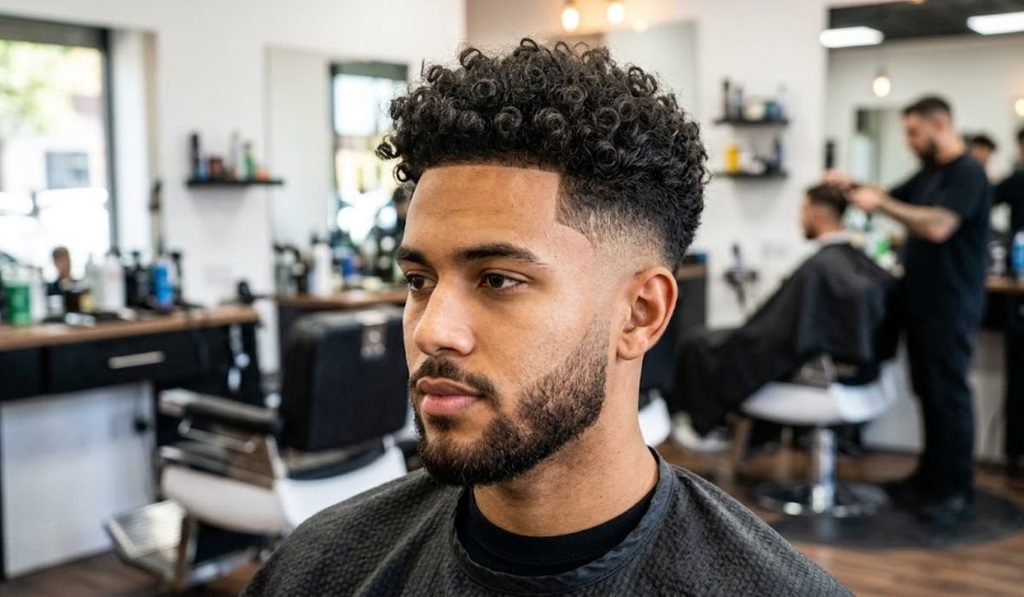
A high taper fade for curly hair is a haircut where the clippers start blending hair just above the temple, cutting the sides and back down to skin or near-skin, while the curls on top are left long enough to show their natural pattern. The height of the fade is what separates it from a mid or low version — it sits higher on the head, which pushes the visual weight of the style upward and creates a sharper line between the shaved sides and the curly crown.
For curly-haired men, this cut does something straight hair can’t: it uses the contrast between tight, clean sides and voluminous curls to make the top look fuller and more defined than it would with a softer fade. It works across curl types — from soft 2B waves to dense 4C coils — though the styling approach and the length you ask for changes depending on your pattern.
What Is a High Taper Fade?
A taper and a fade are technically two different cuts, and understanding the difference helps you communicate better with your barber.
- A taper gradually shortens the hair down the sides and neckline but never goes down to bare skin — there’s always a visible line of hair, even at the shortest point.
- A fade blends the hair all the way down to skin or near-skin, using clipper guards that step down in size.
- A high taper fade borrows from both: it uses fade-style blending (down to skin) but starts that blend high on the head, around or just above the temple, rather than at the ear or the nape.
The “high” placement is the defining feature. It creates more visible skin or short hair on the sides, which means more contrast against the length on top — a look that reads as sharper, cleaner, and more deliberate than a mid or low fade.
Does a High Taper Fade Work on Curly Hair?
Yes — a high taper fade works on every curl type, from loose waves to tight coils. In fact, many barbers consider curly and coily hair to be the textures that benefit most from this cut, because the fade removes bulk from the sides, letting the curls on top spring up and outward without being weighed down by hair underneath.
Here’s a general breakdown of how the cut translates across curl categories:
| Curl Type | General Behavior with a High Taper Fade |
| 2A–2C (Wavy) | Waves look looser and move more freely; the high fade adds contrast that a softer texture wouldn’t create on its own |
| 3A–3B (Curly) | Springy, well-defined curls sit naturally on top; this is often the easiest pattern to style day to day |
| 3C–4A (Coily) | Curls appear denser and rounder; barbers usually cut this hair dry to judge the true shape before trimming |
| 4B–4C (Coily/Kinky) | Noticeable shrinkage after cutting and washing — hair that measures long wet can look much shorter once it dries and coils up |
The one factor that trips people up, especially with tighter curl patterns, is shrinkage. Curly and coily hair often looks longer when stretched or wet than it does once it fully dries and curls back up. If you don’t account for this before your appointment, you may end up with far less length on top than you expected — even if the barber cut exactly what you asked for in the moment.
Read Also More: 20 High Taper Fade for Curly Hair
Will a High Taper Fade Suit My Face Shape?
Because a high taper fade pulls visual attention upward and narrows the sides, it tends to suit face shapes that benefit from added height or a more angular silhouette. It’s rarely a bad choice, but some face shapes get more out of it than others.
| Face Shape | How It Reads with a High Taper Fade | Curly Hair Tip |
| Round | Adds height and vertical lines, helping balance width | Keep curls medium-length on top rather than very short — extra height slims the face |
| Oval | Works well with almost any fade height, including high | Most curl lengths and styles suit this shape |
| Square | The rounded softness of curls contrasts nicely with sharp jaw angles | Slightly looser, less structured curls soften strong bone structure |
| Diamond | A high fade can be flattering but shouldn’t overwhelm a narrow chin | Keep top volume moderate rather than very tall |
| Heart | A high fade can sometimes emphasize forehead width | A mid taper may balance better if your forehead is notably wider than your jaw |
A tip worth passing along from working barbers: don’t just compare your face to a celebrity photo. Bone structure, hairline shape, and curl density all vary from person to person, so the same cut can look completely different on two people with the same general face shape. If you’re unsure, bring a couple of photos from different angles to your consultation, not just one straight-on shot — a barber can read jawline and forehead proportions much better with a side profile included.
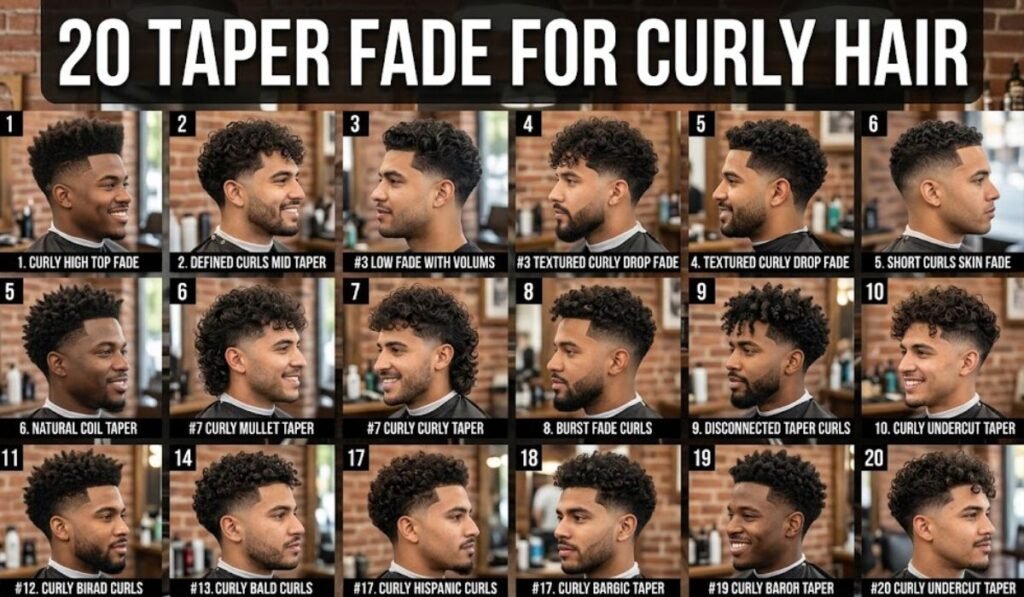
20 High Taper Fade Styles for Curly Hair
Below are 20 variations to bring to your next appointment, ranging from low-maintenance everyday looks to bolder statement cuts.
- Natural Curl Crop — A high skin fade blending into 2–3 inches of curls left in their natural shape, no forced styling required.
- Full Coily Top — Skin fade up to a rounded, voluminous coily crown, best suited to 4A–4C patterns that hold shape well.
- Defined Spiral Top — Distinct spiral curls styled individually for a polished, salon-fresh look.
- Loose Wave Fade — A relaxed, tousled finish for 2B–2C waves, styled with light product rather than heavy cream.
- Curly Fringe Forward — Longer curls left at the front hairline, tapering shorter toward the crown.
- Curly Pompadour — Curls brushed and diffused upward and back for added height and a more formal finish.
- Short Textured Crop — A compact 1–1.5 inch top with visible texture, ideal for minimal daily styling.
- Curly Quiff — Volume directed slightly forward rather than straight back, good for softening a wide forehead.
- Sponge-Curl Top — Short coily hair defined with a curl sponge for a uniform, structured pattern.
- Finger-Coiled Definition — Individual coils shaped by hand for a crisp, salon-styled look on tighter textures.
- Casual Loose Ringlets — Curls left to fall naturally, minimal product, air-dried for an effortless finish.
- Side-Swept Curl Top — Volume directed to one side for a more modern, asymmetric shape.
- Rounded Coil Crown — A shaped, dome-like silhouette on dense 4B–4C hair, cut carefully to sit evenly.
- Undone Textured Top — Deliberately messy curls scrunched rather than defined, for a lived-in look.
- Curly Mohawk Strip — High, tight fade on both sides with a central strip of curls left longer.
- Compact Curl Top (2 inches) — Clean and professional, minimal length, fast to style each morning.
- Long Voluminous Curl Top (4+ inches) — Maximum contrast between the fade and a tall, dense curl crown.
- Hard Part Curl Fade — A shaved line at the temple separating the fade from the curls for extra definition.
- Line-Up with Curly Fringe — A crisp, squared hairline paired with fuller curls up top, popular for sharp everyday wear.
- Symmetrical Shape-Up Top — Coils shaped into a clean, even silhouette during the cut, giving a more architectural finish.
Bring a couple of these to your consultation as a reference point — most barbers find it easier to work from a photo plus a spoken description than from words alone.
How Do You Style a High Taper Fade with Curly Hair?
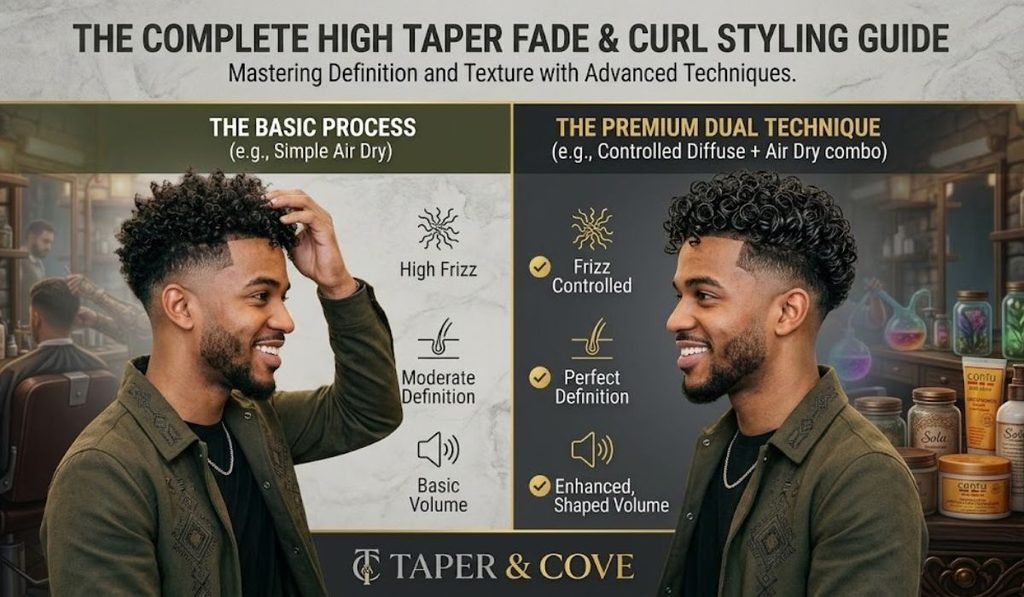
Getting curls to look intentional rather than frizzy comes down to moisture, gentle handling, and controlled drying. A simple routine:
- Start damp, not soaked. Towel-blot after washing so hair is roughly 70% dry before applying anything.
- Apply a leave-in conditioner first. This is the moisture layer that reduces frizz and helps curl cream perform better, especially on coilier textures.
- Scrunch in curl cream. Work from the ends upward in a scrunching motion — avoid rubbing or combing, which breaks curl clumps apart.
- Diffuse on low heat. Keep the diffuser moving and avoid holding it in one spot; high heat can loosen the curl pattern.
- Stop before fully dry. Air-dry the last 10–15% instead of diffusing all the way — over-drying with heat is one of the most common causes of frizz.
- Add a light texture spray if wanted. Optional, and best skipped on very tight coils, which need moisture more than texture products.
What Products Work Best for This Cut?
Product needs shift depending on your curl pattern:
- Wavy (2A–2C): Lightweight mousse or sea salt spray. Heavy creams tend to weigh waves down and flatten movement.
- Curly (3A–3B): A medium-hold curl cream or custard applied to damp hair, scrunched in.
- Coily (3C–4A): Leave-in conditioner as a base, followed by a heavier curl cream for hold and definition.
- Kinky-Coily (4B–4C): Thick leave-in or curl butter, followed by cream or gel, sealed with a light oil to lock in moisture.
Hair porosity also matters. Low-porosity hair tends to resist product absorption, so lighter, water-based formulas work best. High-porosity hair absorbs product quickly but loses moisture fast, so richer creams and a sealing oil help it hold longer.
What Should You Tell Your Barber?
Clear communication prevents the most common disappointment with this cut: walking out with far less length on top than expected. Use this as a starting script:
“I’d like a high taper fade starting just above my temples, blending down to skin on the sides. My curl pattern is [wavy / curly / coily], and I want about [X] inches of length on top after it dries — please cut it dry so you can see the natural curl shape before trimming.”
A few things worth confirming before the clippers start:
- Ask whether they cut curly hair wet or dry — dry is generally preferred, since wet curls stretch and can lead to more length being removed than intended.
- Confirm the exact fade height (just above the temple for “high”).
- Mention your hair’s density so the barber blends gradually rather than leaving a harsh line.
How Is a High-Taper Fade Different from a Mid- or Low-Taper Fade?
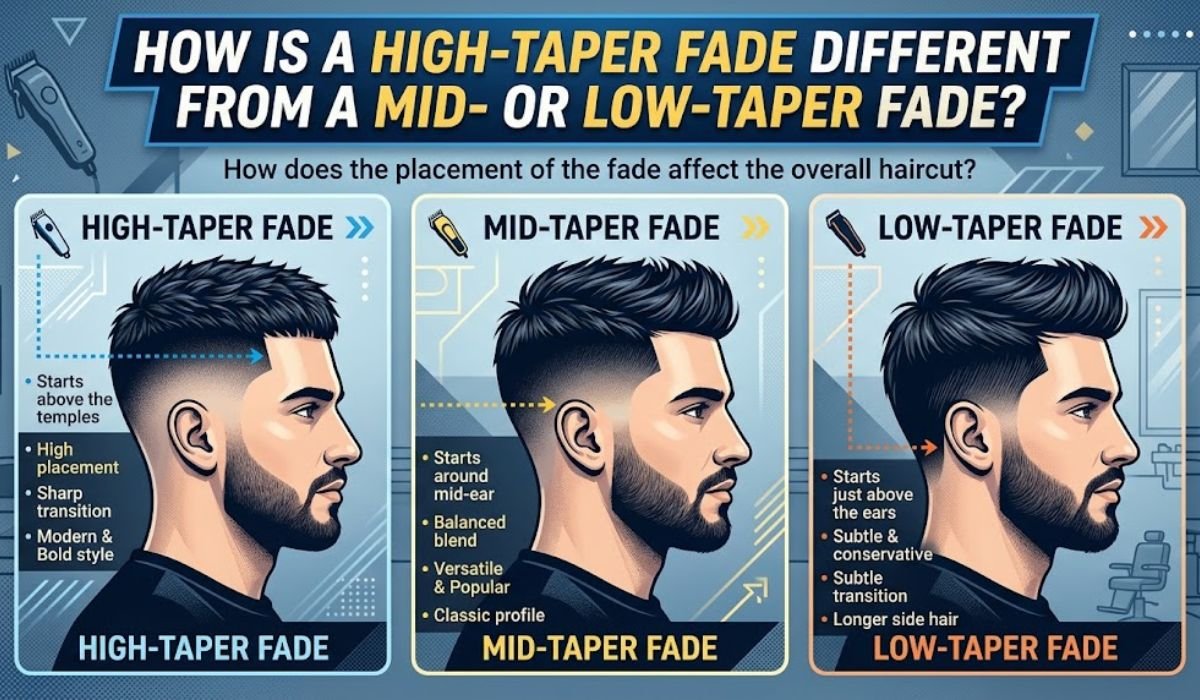
The core difference is simply where the fade begins on the head. Everything else — the blending method, the finish, the top styling — stays largely the same.
| Fade Height | Starting Point | Contrast Level | Grows Out In |
| High Taper | Just above the temple | Highest contrast | ~2–3 weeks |
| Mid Taper | Roughly ear level | Moderate contrast | ~3 weeks |
| Low Taper | Near the nape/bottom of the ear | Subtle, gradual blend | ~3–4 weeks |
A high fade gives the boldest, sharpest look but also needs the most frequent upkeep, since more of the head is affected as hair grows back in. A low taper is the lower-maintenance option if frequent barber visits aren’t realistic for your schedule.
How Do You Maintain a High Taper Fade with Curly Hair?
Two separate things need upkeep here: the fade line itself, and the day-to-day condition of the curls.
Fade touch-ups: Plan on a barber visit roughly every 2–3 weeks. By around week two, the sharp line at the temple starts to soften as new growth blurs the edge; by week four, the cut generally looks overgrown rather than intentional.
Curl care between cuts: Curls don’t need daily washing, but they do need regular moisture. Every couple of days, lightly dampen the top, apply a small amount of leave-in conditioner, and scrunch or diffuse briefly. This keeps the pattern defined instead of dry and frizzy.
A note on DIY touch-ups: Trimming your own neckline is manageable. Re-blending the actual fade yourself is not usually recommended — curly and coily hair grows in different directions across the head, which makes an even blend difficult without training, and mistakes are highly visible against the contrast this cut creates.
Does a High Taper Fade Reduce Bulk?
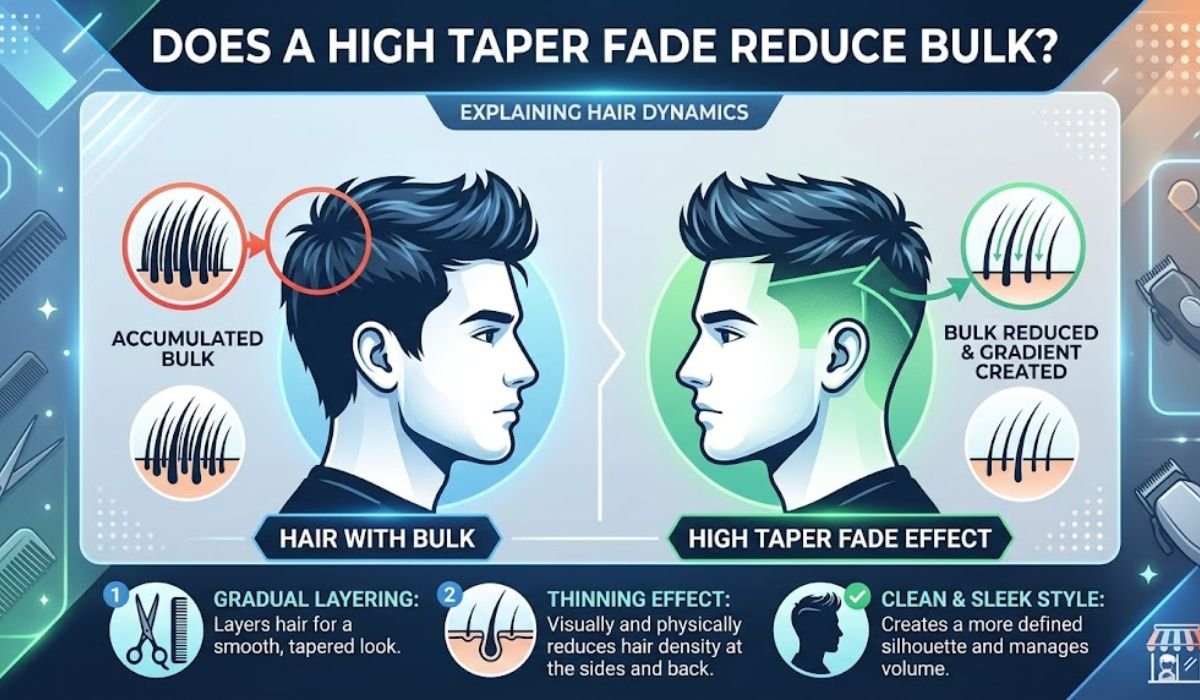
Yes, noticeably. Removing hair from the sides and back takes real weight off the head, which lets curls on top move and spring more freely instead of being pulled down by hair underneath. Practical upsides include:
- Faster drying time, since there’s simply less hair overall
- Less product needed day to day, since it’s only applied to the top section
- A cooler scalp in warm weather, thanks to the shorter sides
That said, the fade doesn’t reduce how much care your curls need on top — moisture, gentle handling, and the right products are still required regardless of how short the sides are cut.
Common Mistakes to Avoid
- Skipping a barber with curly-hair experience. Not every barber is equally comfortable blending around dense or coily textures — ask to see examples of their past work on similar hair.
- Cutting curls while soaking wet. Wet curls stretch, so a barber cutting to a “wet length” target often removes more than intended once the hair dries and springs back.
- Ignoring shrinkage when requesting length. Always describe the length you want once your hair is fully dry, not stretched or wet.
- Over-drying with the diffuser. Pushing curls all the way to 100% dry with heat is one of the fastest ways to trigger frizz — stop just short and let the rest air-dry.
- Skipping leave-in conditioner. Especially on coilier textures, curl cream alone doesn’t provide enough moisture to keep the pattern defined.
- Trying to re-fade it yourself. The blend at the temple is the hardest part of this cut to get right — leave it to a professional.
FAQ’s
Does a high taper fade work on 4C hair?
Yes. Tight coils create strong volume on top against closely faded sides — ask for extra length to account for shrinkage once it dries.
How often do I need a touch-up?
Roughly every 2–3 weeks to keep the fade line sharp and prevent it from growing out unevenly.
Should curly hair be cut wet or dry?
Dry is generally preferred, since it lets the barber see your true curl shape and avoid cutting off more length than intended.
Can I maintain the fade myself between visits?
You can trim your own neckline, but re-blending the fade line yourself is not recommended — it’s easy to create a visible hard edge.
What’s the minimum curl length needed for this cut?
Around 2 inches of stretched length is usually enough to show a defined pattern on top; tighter coils may need more due to shrinkage.
Is a high taper fade the same as a high top fade?
No — a high top fade keeps a very short, boxy shape all over the top, while a high taper fade allows more natural curl length and movement on top.
Key Takeaways
A high taper fade is one of the most versatile, flattering options for curly and coily hair, thanks to the contrast it creates between clean, tight sides and natural volume on top. Getting the best result comes down to three things: choosing a barber experienced with curly textures, communicating your desired length with shrinkage in mind, and sticking to a consistent touch-up and moisture routine. Once those pieces are in place, this cut holds its shape and keeps curls looking sharp, defined, and easy to manage day to day.
High Taper Fade for Black Men: 30 Styles by Hair Texture + Barber Script
For a deeper look at texture-specific guard sequences, styling for locs, waves, and coils, and a full barber script tailored to different hair densities, this companion guide expands on 30 additional style directions built specifically around Black men’s hair textures.
High Taper Fade for Straight Hair: Styling Guide for Volume & Contrast
If you’re comparing how this cut translates to straight hair, this related guide covers how to add volume and contrast without curls, along with styling products suited to fine or thick straight hair.
Conclusion
A high taper fade brings out the best in curly hair sharp sides, natural volume and a shape that suits nearly every face and curl type. Pick a barber who understands textured hair, be specific about length and shrinkage and keep up with touch-ups and moisture between cuts. Do that, and this cut will stay one of the easiest, sharpest styles you can wear.

I’m Joyce
I’m an SEO-focused writer and content creator with experience in creating useful, search-friendly content that helps readers find the information they are looking for. I enjoy researching trends, understanding what people search for, and turning that research into clear and helpful articles.
At Curl Slayers, I focus on haircuts, hairstyles, fades, and curly hair. I research modern hair trends, different haircut styles, and practical styling ideas to help readers discover fresh looks and choose styles that suit them.
My goal is simple: to make hair inspiration easier to find, understand, and use. Whether you’re looking for a new haircut, a clean fade, a trendy hairstyle, or ideas for your curls, Curl Slayers is here to help you find your next look.

1 thought on “High Taper Fade for Curly Hair: 20 Trendy Styles, Face-Shape Tips & Expert Barber Advice”